



Top FAQ Questions
- 1.What is the regulated tariff? [Business]
The regulated tariff is the price charged by SP Group for supplying electricity to consumers. It is approved by EMA, and is based on a formula that takes into account the cost of producing and delivering electricity to consumers over the long term. It is adjusted quarterly to account mainly for changes in the price of fuel (i.e. natural gas) used to generate electricity.
- 2.Will I need to change my meter when I switch to buy electricity from a retailer or from the wholesale electricity market?
As a business consumer, you will need to install an advanced meter, also known as a smart meter or Advanced Metering Infrastructure (AMI) meter, when you choose to buy electricity from a retailer or buy from the wholesale electricity market. This meter will allow you to track your half-hourly electricity consumption. A meter installation fee (inclusive of prevailing GST) will be chargeable. Details are available under Market Support Service Charges.
- 3.Can my electricity retailer cut off my business' electricity supply?
Your retailer cannot cut off your electricity supply. If your retailer wishes to stop selling electricity to you, your retailer is required to inform you at least 10 business days before terminating your contract. Thereafter, you will be automatically transferred back to SP Group at the regulated tariff. You can also choose to switch to a new retailer. There will be no disruption to the physical supply of electricity to your premises when you change retailers.
- 4.What will happen to the consenting sub-metered account holders (i.e. tenants) when the master-metered account holder (i.e. landlord) buys electricity on their behalf?
Consenting tenants will have to close their respective sub-metered accounts with SP Group, as the electricity consumption of these tenants will be subsumed under:
- The master-metered account in the En-Bloc Contestability Scheme; or
- The new sub-metered account (registered under the landlord) in the Demand Aggregation Scheme.
The landlord and tenants will have to agree on the commercial arrangement, which would typically include the electricity rate payable by the tenants to the landlord. Tenants will receive their electricity bill from their landlord or the landlord's retailer. SP Group will no longer bill the tenants for their electricity consumption.
- 5.Are master-metered accounts eligible to switch to buy electricity from retailers?
A landlord or Management Corporation Strata Title (MCST) with a master-sub metering arrangement can buy electricity from a retailer of his choice either under the En-Bloc Contestability Scheme or Demand Aggregation Scheme.
Under the En-Bloc Contestability Scheme, the landlord or MCST (i.e. the master-metered account holder) will buy electricity for the entire premises on behalf of all sub-metered tenants, from the selected retailer at an electricity rate agreed between the landlord and the retailer. The landlord is required to obtain the consent of all the tenants to buy electricity on their behalf.
If a tenant subsequently decides to opt out of this arrangement, all tenants and the landlord will revert to buying electricity from SP Group at the regulated tariff.
A landlord or MCST who is unable to obtain the consent of all tenants can buy electricity from a retailer under the Demand Aggregation Scheme. Under this scheme, the landlord can carve out part of the common services load and the load of one or more consenting tenants under a new sub-metered account. The remaining tenants can continue to buy electricity from SP Group at the regulated tariff, or from electricity retailers if they meet the contestability criteria.
View the guidelines:
En-Bloc Contestability Scheme
Demand Aggregation Scheme - 6.What are Standard and Non-Standard Price Plans?
Standard Price Plans offer all-inclusive electricity rates (i.e. no separate per-kWh fees) with a contract duration of either 6 months, 12 months or 24 months. The electricity rates for Standard Price Plans will not change throughout the contract duration and do not include any recurring charges or fees.
- Fixed Price Plan: Pay a constant rate (e.g. 20 cents/kWh) for electricity throughout your contract duration.
- Discount Off the Regulated Tariff Plan: Enjoy a fixed discount off the prevailing regulated tariff (e.g. 20% off) throughout your contract duration.
You may wish to use the Price Comparison Tool at compare.openelectricitymarket.sg to compare the Standard Price Plans offered by electricity retailers
Non-Standard Price Plans are plans where the electricity rates may not be all-inclusive and may change during the contract duration in accordance to the terms and conditions of the contract. They may also include recurring charges or fees, and retailers have the flexibility to decide on the pricing structure and contract duration.
Please speak to an electricity retailer if you wish to find out more about such plans.
- 7.How do I close my business MSS account?
If you are buying electricity from a retailer, request your retailer to facilitate the closure of your MSS account. In addition, you should also check with your retailer on their requirements and procedures to terminate your electricity contract. Note that SP Group will require at least 8 business days' notice to process your request upon being notified by your retailer.
If you are buying electricity from the wholesale electricity market through SP Group, please submit the Termination of Supply for Contestable Consumer form to SP Group, giving at least 8 business days' notice for account closure. This form can be downloaded from here. - 8.What is EMA’s role in Open Electricity Market? [Business]
EMA is the regulator which oversees the energy sector in Singapore. Its main goals are to ensure a reliable and secure energy supply, promote effective competition in the energy market, and develop a dynamic energy sector in Singapore.
In Open Electricity Market, EMA will continue to promote fair competition while ensuring that consumers' interests are protected. - 9.How far back can I check my business' electricity usage?
You can view your daily half-hourly usage for the last 3 months. You can also view your electricity usage in daily and monthly intervals for the last 3 years on the e-Services portal.
- 10.What does it mean when my retailer tells me that the consumption for my business is loss-adjusted?
When electricity is supplied to consumers, there is some loss of energy when it travels from the power plants (i.e. the source of generation) via the transmission cables to homes and businesses. The amount of loss is dependent on the voltage level where consumers take in their electricity supply. In general, the lower the voltage, the more transmission losses are incurred when delivering electricity from where it is generated to where it is consumed. When retailers buy electricity from the wholesale market, they pay for the actual units of electricity generated. However, this quantity is higher than the recorded consumption registered on consumers' meters. As such, to account for the difference, retailers may apply a Transmission Loss Factor (TLF) to adjust the final consumption that they will use to bill consumers. The Transmission Loss Factor is calculated in accordance to a methodology approved by the Energy Market Authority. More details on Transmission Loss Factors can be found here.
- 11.I am buying electricity from the wholesale electricity market via SP Group. If my meter is faulty, how will SP Group bill me for my consumption?
If your meter is faulty, SP Group will estimate your consumption using the methodology set out in the Metering Code issued by the Energy Market Authority (EMA), and bill you based on the estimated consumption. The Metering Code is available here.
- 12.What is an advanced meter?
Advanced meters, also known as smart meters or Advanced Metering Infrastructure (AMI) meters, are digital meters which allow electricity consumption to be tracked at half-hourly intervals. The consumption data will be transmitted via a wireless network for billing purposes. They allow for electricity consumption to be tracked and read at half-hourly intervals. This will help consumers better understand and manage their consumption patterns. In addition, the consumption data obtained via these meters can also help retailers offer pricing plans that best meet the needs of consumers.
- 13.As a tenant, can I subsequently opt out of the En-Bloc Contestability Scheme or Demand Aggregation Scheme arrangement?
You are advised to check the commercial terms and conditions of the contract arrangement signed between you and your landlord before deciding to opt out of the En-Bloc Contestability Scheme or Demand Aggregation Scheme.
- 14.What documents do I need to submit to make the switch for my business?
The documents required for commercial accounts under UEN are
- Application for Contestability Status
- Business Profile/ACRA
- Letter of Authorisation (Applicable only if signatory in the application form is not listed in the Business Profile/ACRA)
The documents required for commercial accounts under NRIC are
- Application for Contestability Status
- Copy of account holder's NRIC
- 15.Is my company allowed to switch back to buying electricity from SP Group at the regulated tariff?
Only businesses with an aggregated average monthly consumption of less than 4,000 kWh calculated across all its active accounts (contestable and non-contestable) registered under the same account holder are allowed to switch back to buying electricity from SP Group at the regulated tariff.
The aggregated average monthly consumption is calculated based on the account(s) consumption over a continuous period of the past 12 months. If the account is opened for less than 12 months, then the consumption used for calculation will be for the period for which the account has been opened.
Please check with your retailer if there are any early termination fee or auto-renewal clauses.
- 16.What happens if my retailer ceases operations? [Business]
In the event that your retailer ceases operations, your account will be transferred to SP Group. The following default supply arrangements will apply:
- Businesses with an average monthly consumption of less than 4,000 kWh and all households will buy electricity from SP Group at the regulated tariff;
- Businesses with an average monthly consumption of at least 4,000 kWh will buy electricity indirectly from the wholesale electricity market through SP Group at the wholesale electricity prices.
If you who do not wish to be transferred to the default supply arrangement, you will need to submit a request to your new retailer, to be transferred to your preferred retailer.
There will be no disruption to your electricity supply at any time, as you will continue to receive your electricity supply through the national power grid operated by SP Group. - 17.Who are the retailers that I can buy electricity from for my business?
Small business consumers (with an average monthly consumption not exceeding 2,000 kWh) can buy electricity from retailers participating in the Open Electricity Market as listed here.
Business consumers with an average monthly consumption of at least 2,000 kWh can buy electricity from any electricity retailer.
- 18.Are business consumers able to buy electricity from the wholesale electricity market via SP Group?
With the Open Electricity Market, consumers can choose a price plan from any of the participating retailers that best suits their needs. This includes Standard Price Plans, namely Fixed Price Plans or Discount Off The Regulated Tariff Plans. Consumers can also choose to continue buying electricity from SP Group at the regulated tariff or purchase from the wholesale electricity market via SP Group.
The wholesale electricity prices (WEP) vary every half-hour depending on the prevailing demand and supply situation in the wholesale electricity market. It would typically rise with increasing electricity demand and/or outage of generating units. Consumers can refer to the chart below which shows the lowest and highest half-hourly wholesale electricity prices in 2019. For example, in the month of February 2019, the half-hourly prices ranged between 14.32 cents/kWh and 155.82 cents/kWh.
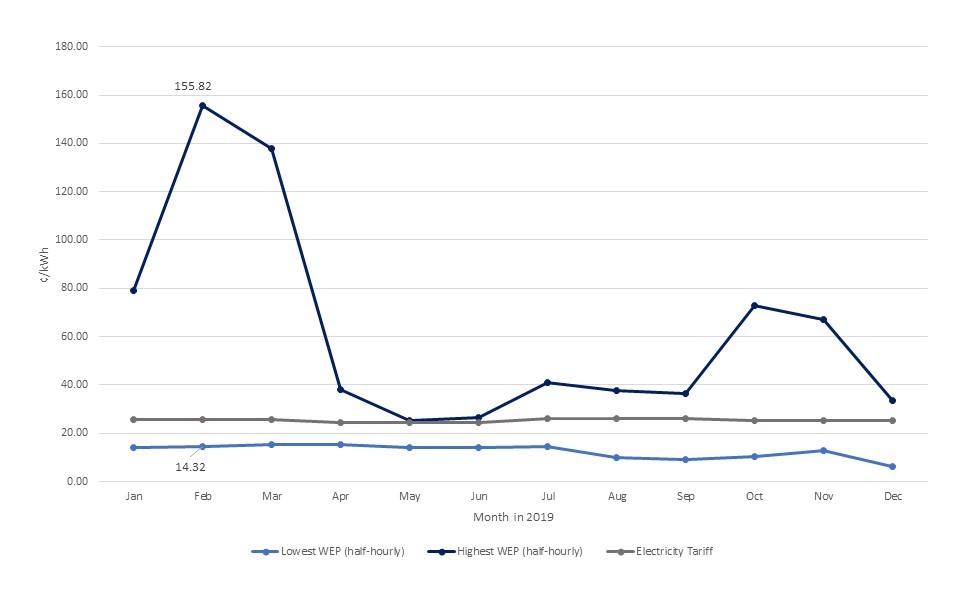 *Source: Energy Market Authority. Figures provide an equivalent charge per kWh under a WEP plan. Actual calculation of charges will be presented in detail in customers’ bills. Figures exclude Meter Reading and Data Management Charge ($2.18 per meter) and Vesting Debit/Credit (if applicable) for the quarter.
 - 19.What is a Market Support Services (MSS) account? [Business]
When you decide to switch to buy electricity from a retailer, or from the wholesale electricity market, a new account - known as the Market Support Service (MSS) account - will be created with SP Group.
As SP Group is the Market Support Services Licensee, it will still continue to provide services to consumers who have switched electricity providers, such as meter reading, meter data management, and other services. - 20.How many days are required to close my business MSS account?
Please inform SP Group at least 7 business days in advance to close your MSS account.